

Why You need to Track Every Product Demo View
In July 2013, Paul Graham published an essay that changed how founders think about early-stage startups. "Do Things that Don't Scale" argued that the path to massive growth often starts with labor-intensive, manual work that would horrify efficiency experts.
Stripe's founders manually signed up their first users, literally taking people's laptops and setting them up on the spot. Airbnb's founders went door-to-door in New York photographing listings. Wufoo sent hand-written thank-you notes to every new user.
These tactics don't scale. But they're exactly what early-stage startups need to succeed.
What does this have to do with product demos?
Everything.
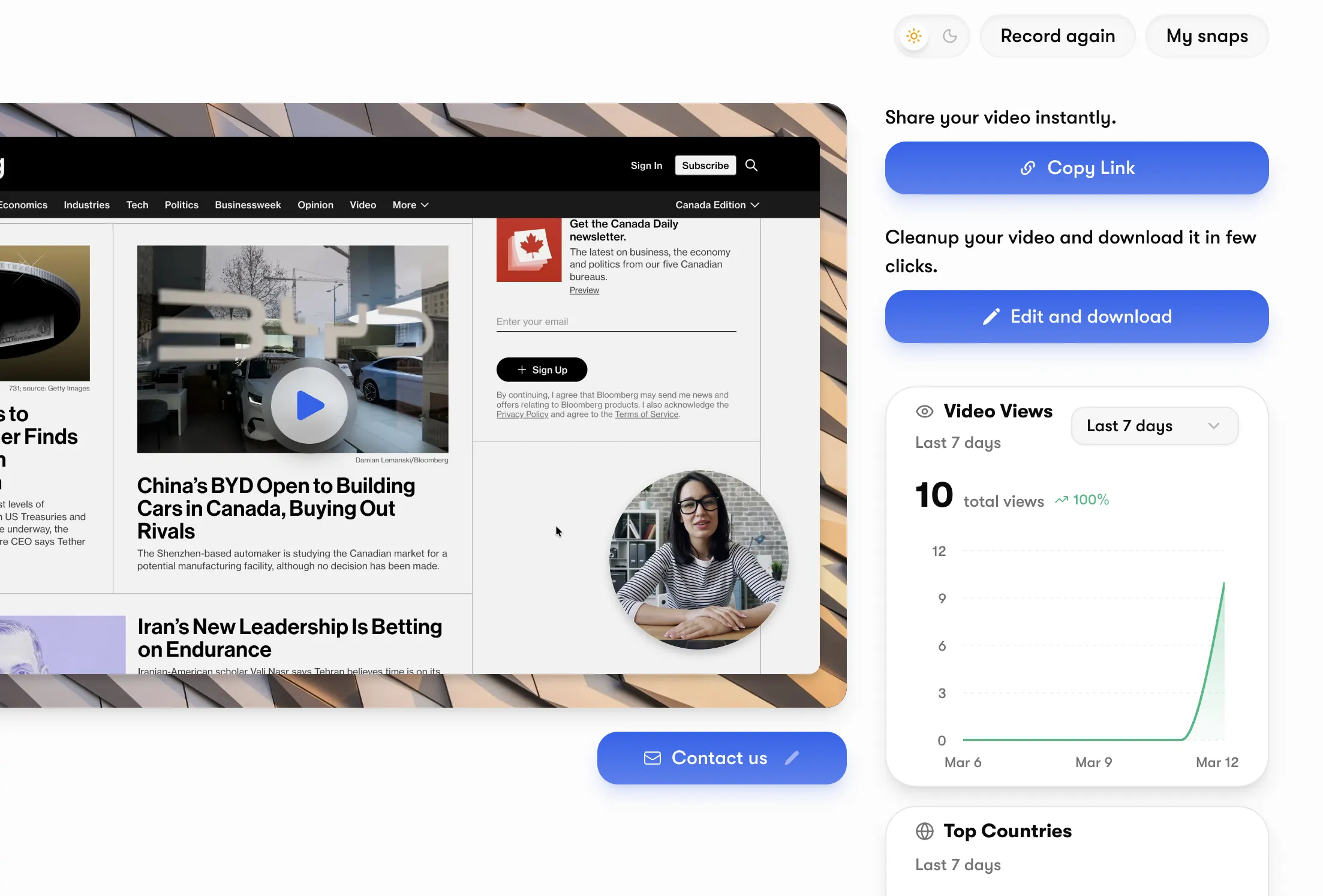
Your product demo is often the first real interaction prospects have with your SaaS. Yet most founders treat demo distribution like a scalable, automated process from day one. They create one video, distribute it widely, and move on.
This is a mistake.
In this article, we'll explore why obsessively tracking every product demo view is the ultimate "do things that don't scale" tactic, and why it's exactly what your startup needs right now.
The Core Principle: Manual Attention Creates Insights
Paul Graham's essay centers on a counterintuitive truth: early-stage startups should do things manually, even when automation is possible.
Why? Because manual work creates insights that automation misses.
When Airbnb founders personally photographed apartments, they learned what made listings compelling. When Stripe founders manually onboarded users, they discovered pain points in the setup process. When Wufoo founders hand-wrote thank-you notes, they built emotional connections that scaled into culture.
The same principle applies to product demos.
When you manually track every demo view, not just aggregate metrics, but individual viewer behavior, you learn things no automated funnel can teach you:
- Which specific features make prospects replay sections?
- Where does confusion cause drop-offs?
- What messaging resonates with your ICP vs tire-kickers?
- How do different personas engage with the same content?
- What questions arise that your demo should preemptively answer?
This level of attention feels inefficient. It doesn't scale. That's exactly why it works.
Why Founders Resist Tracking Individual Demo Views
Before we dive into implementation, let's address why most founders don't do this:
Objection 1: "I Don't Have Time"
This is the classic trap. You're too busy building product to manually review demo analytics.
PG's response: "You can be ornery when you're Scotty, but not when you're Kirk."
At the early stage, you're Kirk, you run the whole show. That includes understanding every customer interaction. The founders who spend time manually analyzing early user behavior build better products faster than those who optimize for efficiency too soon.
The reality: Reviewing demo analytics for 10 viewers takes 30 minutes. That 30 minutes might reveal the insight that transforms your conversion rate.
Objection 2: "It Won't Scale"
Correct. It won't scale. That's the point.
PG's response: "If you can make it happen... that would be a great problem to have."
Right now, you don't have too many demo viewers to track manually. You have too few. The goal isn't to create a process that works at 10,000 viewers, it's to create a process that helps you get there.
The reality: By the time you have "too many" viewers to track individually, you'll have learned enough to know what automation to build.
Objection 3: "I Need Bigger Wins"
Founders often dismiss tactics that don't feel like "big launches" or "strategic partnerships."
PG's response: "The mistake they make is to underestimate the power of compound growth."
Tracking one demo view gives you one insight. Track 10, you spot patterns. Track 100, you've revolutionized your demo strategy. Each insight compounds on the last.
The reality: The difference between a 2% and 4% demo-to-trial conversion rate is the difference between struggling and thriving. You find that improvement in the details, not the big picture.
How to Apply "Do Things That Don't Scale" to Demo Tracking
Let's get tactical. Here's how to obsessively track every product demo view in a way that creates disproportionate value.
Phase 1: Set Up Individual Viewer Tracking (Week 1)
The old way: Create demo, upload to YouTube, share link, check view count occasionally.
The unscalable way:
Step 1: Use Vibrantsnap (or similar) to create unique tracking links for every demo send.
Why: Generic links tell you total views. Unique links tell you who watched, when, and for how long.
Example:
- Prospect A gets:
vibrantsnap.com/demo/prospect-a-outbound - Prospect B gets:
vibrantsnap.com/demo/prospect-b-linkedin - Prospect C gets:
vibrantsnap.com/demo/prospect-c-referral
The payoff: You now know not just "100 people watched" but exactly which 100 people, from which sources, with which level of engagement.
Step 2: Set up real-time notifications when someone watches.
Why: Immediate feedback creates learning loops. You can follow up while the demo is fresh in their mind.
Example notification:
"John from Acme Corp just watched 87% of your product demo, rewatching the automation section twice. Last seen 3 minutes ago."
The payoff: You can send a personalized follow-up email within minutes, while they're still thinking about your product.
Step 3: Create a simple tracking spreadsheet.
Columns:
- Prospect name
- Company
- Source (how they found you)
- Date shared
- View date
- Completion %
- Sections rewatched
- CTA clicked?
- Follow-up notes
- Outcome
Why: Forces you to review every single view and think about what it means.
The payoff: Patterns emerge that raw data doesn't reveal.
Phase 2: Analyze Every View (Daily, 15 Minutes)
This is where the magic happens. Spend 15 minutes every morning reviewing yesterday's demo views.
For each view, ask:
1. Who is this person?
- Do they fit our ICP?
- What's their role and company size?
- How did they find us?
2. How did they engage?
- Full watch or partial?
- Drop-off point (if any)?
- Sections they replayed?
- Did they click the CTA?
3. What does this tell me?
- Is our targeting working?
- Does the demo match expectations?
- Which features resonate most?
- Where are we losing people?
4. What's my next action?
- Personalized follow-up based on what they watched?
- Forward to sales if highly engaged?
- Note for product team if they focused on specific feature?
- Improvement idea for the demo itself?
Real example: A SaaS founder noticed three prospects in one week all dropped off at the exact same moment, when he mentioned the price. He realized he was positioning price before value. He restructured the demo to show ROI first, then price. Conversion rate jumped 28%.
He only noticed because he was manually reviewing every view.
Phase 3: Personal Follow-Ups (The Stripe "Collison Installation")
Remember the Stripe story? When someone agreed to try Stripe, the Collison brothers would say "give me your laptop" and set them up on the spot.
Apply this to demos:
When someone watches your demo, especially if they watch more than 50%, send a highly personalized follow-up.
Bad follow-up (automated):
"Thanks for watching our demo! Ready to sign up?"
Good follow-up (manual, informed by analytics):
"Hi Sarah,
I noticed you watched our product demo yesterday and spent extra time on the automation section (you even replayed it, love that!).
Most founders who focus on that section are dealing with [specific pain point]. Is that something you're facing?
Happy to jump on a 10-minute call to walk through exactly how we'd set that up for your team."
The difference:
- ❌ Generic blast: 2-3% response rate
- ✅ Personalized, data-driven: 25-40% response rate
Why it works: You're demonstrating that you care enough to pay attention. That level of attention is rare, memorable, and builds trust.
Phase 4: Turn Insights Into Product (Weekly Review)
Every week, review your tracking spreadsheet and ask:
1. Pattern Recognition
- Which features do most viewers rewatch?
- Where do most drop-offs happen?
- What questions come up in follow-ups?
- Which personas engage most deeply?
2. Demo Optimization
- What sections should we expand?
- What can we cut or simplify?
- Should we create persona-specific versions?
- Where should CTAs be placed?
3. Product Implications
- Are demo highlights our actual differentiators?
- Do viewers skip features we thought were important?
- What features generate most replay/interest?
- Are we missing features that would increase engagement?
4. Sales Enablement
- What objections surface in follow-up conversations?
- Which messaging converts best?
- What resources do prospects need post-demo?
- How can we better qualify before the demo?
Real example: A B2B SaaS founder noticed that enterprise prospects consistently skipped the "easy setup" section but replayed "security and compliance" 2-3 times. He realized his demo was built for SMB, not enterprise. He created an enterprise-specific demo emphasizing compliance, security, and integrations. Enterprise conversion rate tripled.
The Transition from Manual to Automated
Here's what Paul Graham says about the evolution:
"You'll be doing different things when you're acquiring users a thousand at a time, and growth has to slow down eventually. But if the market exists you can usually start by recruiting users manually and then gradually switch to less manual methods."
The same applies to demo tracking.
When You're at 10-50 Demo Views/Month
Manual everything:
- Personal tracking spreadsheet
- Individual view analysis
- Custom follow-ups for each viewer
- Weekly pattern reviews
Time investment: 2-3 hours/week Learning rate: Extremely high Insights gained: Game-changing
When You're at 100-500 Views/Month
Hybrid approach:
- Automated tracking for all views
- Manual analysis of high-value prospects
- Automated follow-ups with manual overrides
- Bi-weekly pattern reviews
Time investment: 4-5 hours/week (but much more volume) Learning rate: Still high Insights gained: Incremental improvements
When You're at 1,000+ Views/Month
Mostly automated:
- Automated tracking and reporting
- Manual analysis of enterprise/high-value deals
- Smart automation with behavioral triggers
- Monthly strategic reviews
Time investment: 2-3 hours/week (focused on strategy) Learning rate: Moderate (you've learned the key patterns) Insights gained: Refinement and optimization
The key: You can only build effective automation because you did things manually first. You know what patterns to look for, what thresholds matter, and what actions to trigger.
Vibrantsnap: Built for Founders Who Do Things That Don't Scale
This entire philosophy is embedded in how we built Vibrantsnap.
Most video platforms optimize for scale from day one. Vibrantsnap optimizes for learning first, scale second.
Individual Viewer Analytics
Every demo view gets its own detailed profile:
- Complete viewing timeline
- Exact rewatch sections
- CTA interactions
- Source and context
- Notes field for your observations
Why: So you can manually review and learn from each viewer.
Real-Time Notifications
Get instant alerts when:
- A high-value prospect watches
- Someone rewatches multiple times
- A viewer clicks your CTA
- Unusual engagement patterns occur
Why: So you can act immediately, like the Stripe Collison installation.
Manual Review Workflow
Built-in features for doing things that don't scale:
- Add notes to each viewer
- Tag prospects by segment
- Mark for follow-up
- Connect to CRM manually or automatically
Why: So the platform supports your manual process instead of forcing automation.
Graduated Automation
As you scale, Vibrantsnap grows with you:
- Start with manual everything
- Add automated notifications
- Enable behavioral triggers
- Build custom funnels
- Integrate with sales automation
Why: The tool adapts to your stage instead of forcing you to adapt to the tool.
Pricing philosophy: We keep costs low (from $39/month) specifically so bootstrapped founders can afford to do things that don't scale with professional tools.
Real Stories: Founders Who Obsessed Over Demo Analytics
Let's look at three founders who applied this philosophy:
Story 1: The Founder Who Watched Every View
Background: Sarah, solo founder of a project management SaaS for construction teams.
What she did:
- Created unique demo links for every conversation
- Set up notifications on her phone
- Spent 30 minutes each morning reviewing overnight views
- Sent personalized video follow-ups based on what each person watched
Initial reaction: "This feels like a waste of time. I should be coding."
Three months later:
- Noticed that contractors rewatched the mobile app section 3x more than desktop
- Realized her demo led with desktop (her personal preference)
- Rebuilt demo to lead with mobile-first workflows
- Conversion rate jumped from 2.8% to 6.1%
- Discovered that contractors needed "offline mode", this became her key differentiator
Sarah's insight: "I was building the product I wanted, not the product my customers needed. I only learned the difference by obsessively watching how they engaged with my demos."
Story 2: The Founder Who Personalized Everything
Background: Marcus, co-founder of a developer tools startup.
What he did:
- Manually analyzed every demo view
- Categorized viewers by technical sophistication (based on replay patterns)
- Created three demo versions: beginner, intermediate, expert
- Manually assigned the right demo to each prospect
Initial reaction: "Why not just have one demo for everyone?"
Six months later:
- Beginners completing expert demo: 12% conversion
- Experts watching beginner demo: 8% conversion (perceived as too simple)
- Right demo for right persona: 31% conversion
The math:
- Previously: Average 10% conversion across all viewers
- After personalization: Average 28% conversion
- 180% improvement from manual segmentation
Marcus's insight: "Automation would've sent everyone the same demo. Manual review let me see that different audiences needed totally different messaging."
Story 3: The Founder Who Scaled Gradually
Background: Alex, founder of a customer support SaaS.
Month 1-3: Manual tracking, 20-40 views/month
- Learned which features resonated
- Identified key objections
- Built personal relationships with every viewer
Month 4-6: Hybrid approach, 100-200 views/month
- Automated tracking but manual follow-up for engaged viewers
- Created templates based on patterns
- Built FAQ content from common questions
Month 7-12: Mostly automated, 500-1,000 views/month
- Automation handles most follow-ups
- Manual intervention for enterprise deals
- Weekly reviews replace daily reviews
Alex's insight: "If I'd started with automation, I would've automated the wrong things. Manual work taught me what actually matters."
The Unscalable Mindset in Action
Let's summarize the key practices:
Daily Practices (15-30 minutes)
Morning routine:
- Review overnight demo views
- Analyze engagement patterns
- Send personalized follow-ups
- Note interesting patterns
Why it matters: Fresh eyes catch insights you'd miss in weekly reviews.
Weekly Practices (1-2 hours)
Friday afternoon review:
- Analyze week's viewing trends
- Identify what worked and what didn't
- Plan demo optimizations for next week
- Update tracking categories
Why it matters: Patterns emerge over days, not hours.
Monthly Practices (3-4 hours)
First Saturday of the month:
- Deep-dive into conversion data
- Calculate demo ROI
- Plan major content changes
- Review and refine processes
Why it matters: Step back from tactics to see strategy.
The Compound Effect
Week 1: You notice one prospect replays pricing section. Week 4: You realize 60% of engaged prospects rewatch pricing. Week 8: You test moving pricing earlier in demo. Week 12: Conversion rate increases 40%.
None of this happens without manual attention.
When to Graduate to Automation
You'll know it's time to automate more when:
✅ You've identified clear patterns that repeat consistently ✅ You're getting too many views to manually review all of them ✅ Your manual processes have proven effective ✅ You've documented what works and why ✅ You can afford to miss some edge cases
But even at scale, don't fully automate:
Always keep manual review for:
- Enterprise deals
- Strategic accounts
- Unusual engagement patterns
- New market segments
- Product experiments
Paul Graham again: "In the best case, both components of the vector contribute to your company's DNA: the unscalable things you have to do to get started are not merely a necessary evil, but change the company permanently for the better."
The obsessive attention you pay to early demo analytics becomes part of your culture. Even when you're huge, you'll have a data-driven, customer-obsessed approach to demos that competitors can't replicate.
The Competitive Moat of Manual Attention
Here's the secret: Your competitors won't do this.
They'll automate too early. They'll rely on aggregate metrics. They'll miss the insights that only manual attention reveals.
This gives you an unfair advantage:
Better product: You build what customers actually want, not what you assume they want.
Better messaging: You learn which words and concepts resonate through direct observation.
Better relationships: Personal follow-ups build trust that automated sequences can't match.
Better data: You train your instincts on real patterns, making you a better decision-maker.
Faster iteration: You learn and adapt in weeks what might take competitors months.
Conclusion: The Power of Doing Things That Don't Scale
Paul Graham's essay concluded with this insight:
"The need to do something unscalably laborious to get started is so nearly universal that it might be a good idea to stop thinking of startup ideas as scalars. Instead we should try thinking of them as pairs of what you're going to build, plus the unscalable thing(s) you're going to do initially to get the company going."
Your product demo isn't just a video asset. It's:
- The video itself (the scalable part)
- Manual, obsessive tracking of how people engage with it (the unscalable part)
Combined, they form a system that:
- Teaches you about your market faster than any alternative
- Creates relationships that turn into revenue
- Builds intuition that informs every future decision
- Compounds into an insurmountable competitive advantage
So spend that 30 minutes reviewing every demo view. Send those personalized follow-ups. Notice what makes people rewatch sections. Learn from drop-offs.
It doesn't scale. That's exactly why it works.
Start Tracking Every Demo View Today
Vibrantsnap was built specifically for founders who want to do things that don't scale, professionally.
Create demos with built-in analytics:
- Individual viewer tracking
- Real-time notifications
- Detailed engagement data
- Manual review workflows
- Graduated automation as you grow
Start for free — built for founders who obsess over details.
Comparison